


Contents:
- What Botty Is and What It Does Not Do
- How the Botty Algorithm Works
- Botty Strategy Templates: Conservative, Balanced and Aggressive
- How spot and futures differ
- What the Historical Figures Represent
- How Botty Connects to Hyperliquid
- Where Assets Stay and What Botty Can Access
- How the Botty Fee Model Works
- Background: The Team Behind Botty
- What the DigVel Security Audit Confirms
- Botty Reviews: What Users Say
- Time savings and less emotional trading
- Trust in the non-custodial model
- Templates and results
- Ease of use and the first launch
- Living with the bot day to day
- Risks and Limitations
- Botty Reviews: A Balanced Assessment
Evaluating an automated trading platform takes more than reading a handful of opinions. A fair picture of Botty has to cover how the product is built: how it connects to an exchange, where users’ assets stay, which permissions the platform receives, how its strategies are designed, how it earns money and what security documentation exists. Only against that background do Botty reviews become meaningful, because user experience can then be compared with what the platform actually claims to do. This article examines Botty through its current documentation, company materials, the independent DigVel audit and publicly available user reviews.
What Botty Is and What It Does Not Do
According to its current “How Botty Works” document, Botty is a technology platform for automated trading based on predefined rules. Put simply, Botty automates the execution of a selected trading strategy according to predefined parameters. The user chooses the asset, the strategy and the amount; the system then places and closes orders on its own.
Botty does not predict where the market will move, does not sell trading signals and is not a copy-trading service. Its materials frame the approach as “math instead of forecasts”: the algorithm works with price movement itself rather than guessing its direction. The documentation also names the intended audience: not professional traders, but people with capital who do not want to become traders.
How the Botty Algorithm Works
The core of the model is averaging down combined with a calculated order grid. The system splits the allocated capital into several levels and opens a position gradually, starting with a small part of the budget. If the price rises by a set step, the profit is taken and the cycle restarts. If the price falls, a larger order is placed at a lower level, pulling the average entry price down. Once the price returns above the average by the set step, the whole position closes and a new cycle begins from the current price.
This differs from a classic grid bot, which uses a fixed step and fixed order size inside a narrow preset range. In Botty, the spacing and size of each order are calculated individually: orders sit progressively further apart and each one is larger. According to the company, this covers a deeper price range with the same budget. The grid is asset-specific, calculated separately for BTC, ETH and SOL and built on at least five years of market history.
The materials stress that the model suits only liquid, fundamentally strong assets that have historically recovered from deep declines, and that it is not designed for memecoins. Current templates cover BTC, ETH and SOL, and the documentation states that the same principle applies to fundamentally strong, liquid stocks, describing the templates as built around strong crypto assets and equities.
Botty Strategy Templates: Conservative, Balanced and Aggressive
Instead of building a grid themselves, users can pick a ready-made template in one of three categories:
Conservative — a spot strategy without leverage and with lower trading frequency.
Balanced — a futures strategy with a wider grid: fewer trades, designed to handle deeper drawdowns.
Aggressive — a futures strategy with a tighter grid, more frequent trading activity and higher sensitivity to sharp moves.
The September 2026 investor presentation lists nine ready-made strategies, three each for BTC, ETH and SOL. The documentation also states that experienced users can build their own settings.
How spot and futures differ
In a spot strategy, the user buys the actual asset into their own account. If the price falls below the grid, the asset stays in the account and no loss is realized until it is sold; there is no liquidation mechanism.
Futures templates trade a contract on the price using leverage, which allows a larger position but introduces liquidation risk: if the price moves past the grid without pullbacks and margin is insufficient, the exchange can force-close the position at a loss. By default, futures strategies split capital 50/50 between an active allocation and a reserve held as margin, and the user can raise the reserve, for example to 30/70, pushing the liquidation zone further away at the cost of lower potential. The presentation lists leverage of x4 to x6 for the futures templates. The platform shows headroom, filled and pending orders and the average entry in real time, and says it warns users when the market approaches a stress scenario. These tools reduce liquidation risk; they do not remove it.
What the Historical Figures Represent
Before a template is launched, Botty displays pre-calculated history for it: results by year and month, the maximum historical drawdown, the shortest, average and longest time in a trade, the available headroom and the grid itself. The presentation also lists the number of trades per strategy.
The history covers at least five years of data in total; depending on the asset and template, the presentation shows data beginning between 2018 and 2023 and continuing into 2026. The historical average annual figures shown for Botty’s ready-made templates range from approximately 8% to 58%, depending on the asset, strategy category, parameters and testing period, with Conservative templates at the lower end and Aggressive ones at the upper end.
These are calculations on past market data, not a forecast, a guaranteed return or a typical user result. The current public version does not offer a separate tool for running custom historical tests; users see the pre-calculated history attached to each template. The presentation also cites a stress example from October 10, 2025, when BTC fell sharply within an hour, and states that Botty’s automations were not liquidated that day; this is a company-reported example rather than independent evidence.
How Botty Connects to Hyperliquid
Botty is currently integrated with Hyperliquid, a decentralized exchange. The connection is authorized through a crypto-wallet signature using Hyperliquid’s official Builder Code mechanism, and Botty receives permission to execute trading operations only.
The documented flow is short: create a Botty account, connect a wallet to Hyperliquid, choose an asset and a template, decide on the allocation and press “Launch”. Users starting from scratch are guided by instructions, an AI assistant and the support team. For those allocating significant capital, the materials describe separate personal assistance from the team; this is not presented as a standard feature for every user.
Where Assets Stay and What Botty Can Access
Botty does not accept deposits and does not hold users’ funds. Assets remain in the user’s own Hyperliquid account, which the user controls. Botty is not an exchange, broker, fund or custodial wallet; it acts as a technology layer that executes the chosen strategy.
According to the documentation, Botty has no right to withdraw funds, and this restriction is enforced at the exchange level rather than simply promised. The user can stop the automation at any moment, and the presentation adds that access can be revoked, stopping the bot immediately. Because Hyperliquid records trading activity onchain, the trade history is publicly verifiable. This architecture addresses custody, not market risk: positions can still lose value.
How the Botty Fee Model Works
Botty uses an activity-based fee. Its charge is incorporated into the Hyperliquid trading fee through Builder Code and applies when the relevant trading operation is executed. If the bot does not trade, Botty does not charge a fee. There is no subscription, no upfront payment, no charge on profit, no capital-management fee and no fee for withdrawing funds. The current rates are:
Futures: a 0.1% markup on the value of each executed order, regardless of maker or taker.
Spot: a 0.3% markup on the order value, charged only on sell orders.
No Botty fee is charged while the bot is adding to a position. Because spot fees apply only on sell orders, a spot cycle is charged once, at the moment the bot sells and realizes the result.
Because Botty has no withdrawal permission, it never debits fees from the user’s account; the charge is simply part of trade execution on Hyperliquid.
Background: The Team Behind Botty
Botty was founded by Oleksii Ostapovskyi. The following details are company-reported and are not presented here as independently verified:
the investor presentation states that the product launched in March 2026;
the September 2026 presentation lists a team of 31 people;
company materials refer to the founder’s previous crypto academy with more than 40,000 graduates, whose graduates, according to academy materials, generated $9.5 billion in Bybit trading volume in 2025;
as of September 2026, the presentation reports approximately $3.35 million in capital at work and 214,088 closed trades during the first five months.
What the DigVel Security Audit Confirms
Botty underwent an independent security audit by DigVel. According to the documentation, it included penetration testing of botty.com, the certificate is dated April 21, 2026, and the results can be checked on DigVel’s website. The presentation adds that all identified issues were closed. Botty also states that it undergoes independent audits regularly; the DigVel audit is the specific documented example. An audit confirms that an independent assessment took place, not that no vulnerability can ever appear.
Botty Reviews: What Users Say
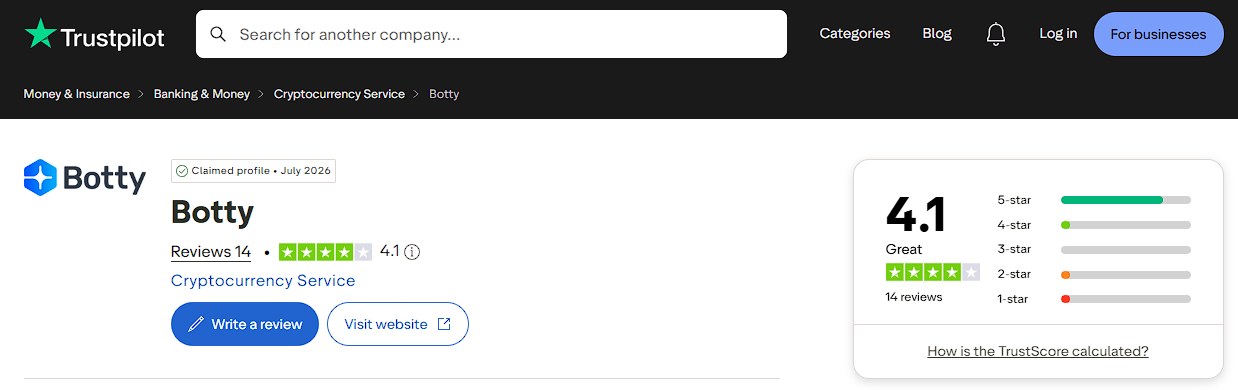
The only public review source identified for this platform is vidhuk.ua, a Ukrainian review site. At the time of analysis, its Botty page showed 36 reviews with an average rating of 4.1 out of 5, written during 2026; thirty were visible and analyzed thematically. This is a small, self-selected sample, and the opinions are users’ own descriptions rather than verified facts.
Time savings and less emotional trading
The most frequent theme is that Botty runs in the background while users get on with their lives. Reviewers mention full-time jobs, long-haul driving, parental leave and holidays with limited connectivity, and several say they now check results weekly instead of watching charts. A related pattern is the removal of emotional decisions: several reviewers say they previously lost money through panic selling, chasing hype or trying to win back losses. One says Botty replaced paid signal subscriptions; another prefers it to copy trading because he can see the logic behind each action.
Trust in the non-custodial model
Many positive Botty reviews mention that funds stay on the user’s own balance and that the platform cannot withdraw them; for some, including one who had earlier lost much of his savings in crypto, this is the main reason for trust. A self-described developer says a test grid on ETH behaved as described. A few older reviews describe the connection in terms of an earlier setup; the current model is the wallet signature through Builder Code.
Templates and results
Conservative template users describe results as modest or slow and value the absence of liquidation risk. Futures users mention leverage limits and keeping half the budget in reserve, and one found the AI assistance useful at night. Some older reviews use previous risk labels, refer to testing strategies themselves or describe the fee as tied to profit; these points do not match the current version of Botty described above. Several users call the dashboard clear and the reports easy to read, and one reports six months of stable operation. Described results are mostly qualitative, such as steady or modest, and one long-term reviewer notes the service suits a calm, passive approach rather than those seeking high gains.
Ease of use and the first launch
A recurring theme in the Botty reviews is how little setup the service requires. Several reviewers say they configured a grid once and then left it alone. This matches the documented design, in which the user makes only a few decisions (asset, strategy, amount, launch) and the order grid is already calculated inside the template. Less experienced users describe the ready-made templates as what made starting feel manageable. More advanced users describe a different benefit: one reviewer who set his own parameters values being able to see the logic behind each action, and the developer mentioned above checked that the grid behaved as described.
Living with the bot day to day
Some reviews describe how Botty fits into household routines. One reviewer says she runs a conservative grid while on parental leave and checks it weekly, finding the reports short and clear. Another writes that her husband used to trade manually late at night and that the household became calmer after he set up a grid. A husband and wife describe each running a bot and comparing results at weekends. A long-haul driver reports that his ETH grid produced dozens of small closed trades in its first week and got through two price dips,. These are individual accounts, but together they illustrate the passive use the documentation describes.
Risks and Limitations
Trading carries a risk of losing capital, and automation does not change that. Results depend on market conditions and strategy parameters, and historical figures do not guarantee comparable future results. Spot and futures templates have different risk profiles; futures use leverage and carry liquidation risk, which a larger reserve reduces but cannot eliminate. An open position may stay in drawdown for days or weeks, tying up capital, and lower volatility produces fewer trading cycles. Positive reviews do not guarantee the same experience for another user.
Botty Reviews: A Balanced Assessment

Documented characteristics include the wallet-based connection to Hyperliquid through Builder Code, trading-only permissions, assets remaining in the user’s account, onchain trade records, the activity-based fee and the three template categories. The DigVel penetration test provides independent security confirmation for a specific date. Team and traction figures are company-reported as of September 2026, and template returns are historical calculations.
Reviews on vidhuk.ua lean positive, with recurring themes of time savings, calmer trading and trust in the non-custodial setup, together with appreciation for clear reports and a short path from account creation to launch. Overall, the materials describe Botty as a young, rule-based automation platform with a transparent architecture and clearly stated risks; whether Botty fits a given reader depends on their risk tolerance, chosen template and readiness to hold positions through drawdowns.